Saturday, May 12, 2007

Bolivia Blur

Alas, we can see the bottom of our pot of gold. Every country we’ve visited has kept us longer than we had planned and now we need to book it to Buenos Aires to get the van and us back to North America (to start saving up for the return to the countries we’ve missed). Our plan from here is to stuff the car into a box in BA, travel by bus through Uruguay and on to my Dad’s house in Southern Brazil. Then we’ll fly to NC to meet the car, pack our stuff into the trailer and visit folks on our way to Vancouver. Of course Moab is on the way – anyone interested in meeting us out there?

Upon crossing the border into Bolivia it was immediately apparent that the pace of things here are just a bit more relaxed. I had to wake up the border guard to get the car paper work done. Probably a boring job considering everyone just went around the other side of the building with all their goods piled high on the trici-taxis. The large sign proclaiming the need to declare your goods was an amusing detail. Then a local policeman tried to charge us for crossing the bridge, which we had already paid someone on the other side. On the advice of the immigration guys we just drove by him, he gave chase for about 20 meters on foot until we disappeared around a corner. Had he run a bit further he would have caught us stuck behind a parade that covered the entire street with people in amazingly colourful indigenous regalia, gold and red and yellow, playing pan pipes and dancing.

We soon get to our first police check point. This is a gate across the road and a small building. We sit in the van for a spell waiting – nothing. Finally I get out and walk over to the building, this is apparently how its done! He says I need to pay a voluntary amount of 10 Bolivianos. I say that’s too much, half distracted by the porn calendar posters hanging up behind him, and end up giving him the 1USD. On the smaller roads the local traffic would just drive under the raised gates, and upon seeing us the cop would walk out, lower the gate, and walk back into his shack, evaluating how much of a donation we are worth. By the time we got to Tupizza, in the south, Kim gets into a very un-Canadian argument with the cop about the terrible condition of the roads and the lack of signage and that she’s just not going to pay. Actually, I guess that’s very Canadian, expecting every thing to be in order and just so.

The paved roads in Bolivia are excellent, much like Peru’s. Unfortunately the main attraction that I wanted to see is the largest salt flat in the world, the Salar de Uyuni, and it is not on a paved road. A quick squiz at the map and the Salar looks bigger than lake Titicaca and the 500km of secondary road was no deterrent. The pavement ends just south of Huari. The beginning seemed much like any other dirt road and we decided that the reports of needing a 4x4 were exaggerated.


We spent the night near the road just south of Rio Mulatos after a long day of washboard and river crossings.

The sunset was great and then there was the silence. All you could hear was the blood running through your ears. I just sat for an hour listening to the silence. While eating breakfast after a great night in the altiplano I said ‘hey look, emus!’ Kim, the biologist, looks up sleepily from her oats and says, no, those are just llamas. Then she looks again, drops her oats and lunges for the binoculars. Emus!

Then came THE detour. A sign said ‘this way for the direct route to Uyuni’ Here the road started following river beds, this would be the case for a quarter of the trip to Uyuni, and deteriorated into tracks across the desert and river crossing that created bow waves that washed up onto the windscreen. This is when the joke ‘this looks like the main road’ started, Kim would say this anytime we were on a track that looked like it had been used in the last year. At a high point we actually pulled out the binoculars trying to see anything at all. We spotted a village in the distance and headed for it. Upon arriving a guy comes running out to greet us. It turns out he’s been waiting for days for a ride to Uyuni, and he knows the way. He says its just three of them and I see two kids next to their packed bag. Sure I say, that shouldn’t be too much extra weight for Tortuga. He’s practically kicking up his heels as he runs back to collect his wife, mother in law, everything they own, and the two kids (I guess kids don’t count). They fill the entire back of the van. Thank god for the new air-springs! This is when Tortuga really came through, climbing slick rock, ploughing through hundreds of meters of soft sand, climbing impossible ravines. It really reminded me of a 4x4 trip to Moab with David – except we didn’t have any beer with us here. I know if David were here that would never have happened!


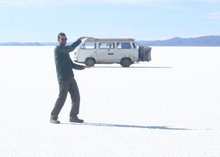
The Salar didn’t so much appear, as the ground in front of the distant mountains disappear. Then the horizon started turning white. I knew the last two days of goat tracks across the dessert would be worth it. We deposited the family on the main road in Colchani, the entrance to the Salar. The Salar isn’t like the salt flats in the US, its actually the remnants of an ocean and is still 100 meters deep with a ½ meter crust of salt on top. There’s the danger of going through but we decided if we followed other tracks we should be OK on our way out to Isla Pescado an island made of petrified corral and covered in huge cacti, pretty surreal, 70km across the salt. Getting onto the salt is reportedly the tricky part although everything was nice and dry for us and it was pretty easy.


Right at the edge there are guys piling salt into neat little piles to dry, by hand of course. Driving on the perfectly flat salt with its hexagon pattern is amazing. We kept wanting to call it ice. Arriving at Isla Pescado, thank golly for GPS, we parked on the shore on the opposite side of the tourist area thinking this would be free. It’s not, 10 Bolivianos each that goes into a fund for the local community, this year its for electrification of the village

We spent the evening riding bikes, cooking, listening to the silence, enjoying one of the best sunsets of the trips and watching the Salar change colours with the changing light. And we ended this wonderful day in a very decadent way – watching Battlestar Galactica. Thank you Darcey for giving us the idea to download them through ITunes.

Turbo Liberation


Arriving at the Lima airport (very nice flight on an Airbus 319) I haggled a cab down from 40 Soles to 25 Soles (10USD) to take me to DHL. On the way there he tells me that today is a national holiday and they will be closed. This, in addition to the fact that DHL was across the road from the airport did not put me in the best spirit. After calling him a thief he offered to take me anywhere I wanted to go for another 15 Soles. I asked him if he understood what I had just said, about him being a crook and all. Being in the middle of an industrial zone I decided to have him take me to Miraflores. This is a suburb of Cusco reputed to ‘not be in Peru’.

Once I got settled in at a nice hostel in Miraflores I set off exploring. Everyone was right, the convertible Lexus’s, Land Rover Disco’s and Limo’s made me feel like I was in Cary. And then there was Vivandas. It’s a Whole Foods, only with nicer produce (in addition to the SA fruits) and it’s 24hrs. Not Peru.

The electric fences around every house and private guards with Uzzi’s on every corner affirmed that these people were uncomfortable with their wealth in a country dominated by poverty.

The beaches are stunning. Comprised of stones about fist size, the receding waves make a magnificent sound. I spent several hours just sitting and listening.

Then I stumbled across LarcoMar. A very upscale mall, complete with a Starsucks. I took in a movie.

The next morning, I arrived at DHL at 8:30 and waited for over an hour for Milton Velasquez. I don’t think his employee manual translated the “express” in DHL Express. I was then told I needed to go and plead my case with Customs (window 14 he tells me). At the customs house I started the standard goose hunt. Window 14 only does packages over 50 kilos, you need window 7 I was told. No, you need window 4, actually, you need Jorge Torres in window 2. Jorge didn’t let me finish telling him about how I’m on honeymoon and my wife is in Cusco before he sprang to action. He called over an assistant to pull my paper. Run run he said. He called DHL and told them to release the package to me within the hour. He begged my pardon and yelled to a DHL employee in the customs area to have him take me in the DHL van back to the DHL building. By this time he was speaking such fast Spanish I didn’t catch most of it but before I knew it I was back at DHL. Milton dragged himself down to meet me, obviously post verbal lashing by the guy in a suit behind him. This guy apologized profusely for the hold up and sent me out the door with the brand new turbo. There was supposed to be 150USD import duty but no one said anything about it. I sprinted around the first corner.

I walk across the street to the airport and had missed the last plane to Cusco by 10 minutes. Drats, another night in Lima with no Kim. The next flight was at 4am. OUCH. I booked a seat on it and headed back to Miraflores. My plan was to watch a late movie and head back to the airport and practice my juggling until 4.

As luck would have it, Spiderman 3 opened at midnight. I could occupy my entire evening strolling the wonderful parks of Miraflores and watching movies! Not to spoil it for my readers, but the guy next to me in Spiderman slept with his head on my shoulder through most of it.

A cab got me back to the airport just in time to check in and get on the flight. I had been very careful with seat selection so that I could see the wonderful Andes from the other side of the plane. Walking onto the runway in the dark made me realize this was all for naught.

Flying back over the countryside we had driven a month ago was like Cliff Notes. The desert leading into green valleys leading into snow covered peaks. Wonderful!

I’m writing this parked on the main square of Chuquito next to the police station. There are 2 marching bands consisting of two drummers and 10-15 guys playing pan pipes dueling it out! Pan pipes!! These aren’t the guys you see in tourist restaurants, playing ABBA for Europeans and North Americans. These are guys in jeans, with backpacks on, and maybe a beer in their hand, stomping around in the square with their neighbours and friends, rocking out on their pan pipes. This is fantastic.

Or, it would be, if after two hours they’d played more than one song, over and over and over…!

Tuesday, May 1, 2007

SNAFU


We have been really enjoying a lot of the things that make the third world the third world - the markets, the riotous colors, the anything-goes attitude. Of course, there is a flip side to that coin, and right now it is staring us in the face - the corruption, the brainless bureaucrats, the ENDLESS hassle.

We decided to have the turbo shipped to us from the US, at great expense, because the van won't go without it. Well, actually it will, but it will only have about 25-30 hp, and we would be driving to Argentina at 20 mph. That wouldn't be any fun, and we still have thousands of miles to go before the end of our trip.

So, we found a turbo, and had it shipped to us by DHL.

On Monday, yesterday, it arrived in Lima. This is where things got $%^&#$ed up. We got an e-mail saying that they couldn't import our package into the country because importation of used car parts isn't allowed.

First, the turbo is brand new. Our shipper didn't mark the box labelled 'used' on the DHL label. So we don't know why they think it's used. Doubtless some nasty bureaucrat is trying to line his pockets and make our lives difficult.

Second, we're not trying to import the part - we're in transit, and will be leaving this backwater as soon as we can put it in our car and drive away.

Sigh. There was no convincing anyone of this over the phone, so this morning, Tuesday, May 1, Douglas got on a plane to Lima, on a mission to liberate the turbo from the dastardly customs agents. He has a real flair for convincing government officials that they would rather help than hinder us. I think it's his cute smile.

Unfortunately, we didn't realise (and the folks we talked to yesterday at DHL didn't tell us, even though we said he was coming to Lima today), that today is a national holiday and EVERYTHING is closed. So poor Douglas is stuck in Lima by himself, waiting for customs to open so he can argue with corrupt bureaucrats. Lima's not exactly a nice city (to put it mildly) - it's huge, dirty, and has more than its share of crime and corruption.

That's all for today - I'm off to make voodoo dolls of witless customs agents.

o, and keep an eye out for new posts from a while ago - I'm working on catching up on our blogging from while Beulah was visiting us. I'll post them in the order they occurred, so the new ones won't always be at the top.

Saturday, April 28, 2007

Ay, Caramba


The roads have been hard on poor la Tortuga, and the turbo is broken.

The little thing inside that spins is supposed to have .5mm of wiggle, and it has 4mm!! So we’re stuck in Cuzco for a few days at least (we hope not more) waiting for a part. It’s Sunday the 29 of April, and we’ve been here for…2 weeks already.

Luckily, we couldn’t be stuck in a nicer place. Quinta Lala is a haven. It has everything we need, is right in a wonderful city, and is chock full of friendly and interesting travelers. We’ve probably met more people here than we have on our entire trip. We’ve been having a great time exchanging stories, places to camp, road recipes, and drinking boxed red wine. Apparently in Chile, all the wines come in boxes as well as bottles, and the quality is the same. It probably has something to do with the roads, and the impossibility of transporting glass bottles intact on terrible dirt or gravel roads. We certainly appreciate it!!

Douglas has been making friends by fixing everyone’s trucks – so far he has fixed Colin and Liz’s Ford (twice – that’s Ford for you) and two Land Rovers. We’ll see who’s next.

In the meantime, we’re taking advantage of the time to organize our lives. We have 6 weeks of travel left, at which point we’ll ship the van from Buenos Aires (assuming we make it there!) to the east coast of the US, where we’ll pick up our dog, Saira (she decided she didn’t want to come on this trip – too much time in the car). The van will be 3 weeks in transit, and we plan to spend that time visiting friends in NC and Boston, then we’ll pack everything in the van and drive over to Vancouver, where we’ll settle.

In the meantime, here’s an update of where we’ve been this year, and how long it’s taken us:

USA, NC to Texas: 2000 miles in 4 days
Central America, Mexico to Panama: 4000 miles in 2 months
South America, Ecuador to Peru: 3000 miles in 1 month

So far we’ve traveled 9000 miles, and we think we have between 2500 and 3500 miles to go, depending on which way we go, and what the roads are like. We hear they're pretty bad in Bolivia, but quite good in Argentina, Uruguay, and Brazil.

And, yes, people actually say ‘Ay, caramba’ here. It’s my new favorite curse. I don’t know exactly what it means, but the taxi drivers say it whenever something goes wrong.

Friday, April 27, 2007

Altiplano and Sillustani Ruins


On our way back to Cuzco, we decided to stop at the Sillustani ruins near Puno. We turned off the main ‘highway’ onto a small road that wound its way through a bewitching altiplano landscape.


At one particularly beautiful adobe compound, we stopped to take pictures, and the friendly family living there waved us in to see more. The kids were all wearing multicolored hats, and one of the women was wearing my new favorite type of hat, a tiny brown bowler perched at an angle, with a little tassle.


They showed us around their home, composed of several small round adobe buildings surrounding a courtyard.


In the back was a small pen for guinea pigs, a local delicacy. In this picture you can just see that there is a small hutch at the back for them to hide in, with a hole as a doorway. One of the guinea pigs was too fat to fit through the doorway anymore – we figured he was going to be lunch!!


When they were done showing us around the rest of the house, they took us into the weaving room and showed us their wares. Of course. Everyone’s gotta make a living. We bought one weaving made of llama, rather than the usual alpaca. Llama fiber is usually used for ropes, and has a coarser texture. It was actually quite soft, though, and reminds me of raw silk in its combination of strength and suppleness. The undyed llama wool had a really lovely shading of colors from palest cream to warm brown. One of my favorite textiles. I wish I had a picture of it to include, but I forgot to take one before I sent it back to NC with Beulah – she generously offered to take some of our extraneous junk home so we could have room to move in the van again!

Finally, since we will be passing through this way again (if we ever get our car part and get to leave Cuzco), we took some family portraits, promising to print them and give them to the family on our way back through. They were quite amazed that they could see the picture immediately on the screen of our digital camera.


Next we headed over the Sillustani ruins, which are pre-incan funerary towers.


I also got this nice picture of a woman spinning by the side of the path:


And just before we got back to Cuzco we passed through a small town fill to the brim with Sunday marketgoers in all their finery. The hats are just splendid.


Lake Titicaca

After seeing Machu Picchu, we took a rest day and then headed south to the other main attraction in southern Peru, Lake Titicaca, home of the famous floating islands. The drive through the altiplano was stunning, with big snow-capped mountains on either side. We only made it as far as Pucara, unfortunately, and ended up staying in one of the eccentric “Turistic Hotels” that are so plentiful in Peru. We took off early the next morning for Puno, and arrived early in the day. We got Beulah settled into a hostel, and we found a parqueo run by a friendly family, then grabbed a taxi to see some of the small towns scattered along the southern shore of Lake Titicaca.

We went first to Chucuito, which is famous for its Temple of Fertility. As soon as the taxi pulled into the central square of the sleepy little town, two small kids approached and offered to be our guides. They of course had finger puppets on, hoping to make a sale. They were quite the young entrepreneurs, and even had a sales pitch worked up where they spoke in unison in sing-song voices. We were a little weirded out at the thought of having the Temple of Fertility explained to us by 5-year olds, but decided that they were old pros, and so we hired them.


The Temple is an old Inca site where women would come to make offerings of coca, hoping the gods would favor them with children. The central part of the temple, which no longer has a roof, is filled with carved stone phalluses, some as big as 4 feet! The older guide told us most of the story, then poked his business partner in the side to get her attention, and they ended by saying “and that concludes the story of the Temple of Fertility” in unison. They were pretty cute. When we paid them, we asked them who got to keep the money, and they said it all went straight to their mother, so we paid them with some chocolate, as well.


On our way back to Puno, we stopped at the tiny lakeside village of Chimu, where they are famous for making the reed boats. It must have been the wrong season or day, because we didn’t see any boat building, only reed-drying. Luckily, there was one small house that doubled as a museum and boat souvenir store, so we stopped. We first looked around the museum, where they had a spectacular collection of replicas of local birds and animals, and a large reed boat carrying the Inca King and his wife. It was pretty impressive, so we resolved to buy a small boat or two.

When we went downstairs, some of the boatmakers came out of their boatmaking room/living room to answer our questions, and to ask questions of their own about where we are from, what it’s like, etc. It turned out that one of the boatmakers was also a boat racer, who regularly takes part in (and wins!) the annual reed boat race on October 22.

The next day we took a guided tour out to the floating islands. The boat was typical for here, and only had one speed. When they wanted to start or stop it, the captain would leave the wheel and head to the back of the boat, lift a wooden cover on a hatch, and fiddle with the engine. Typical, yes. Safe, maybe not.

We arrived on the floating islands to see a veritable army of locals ready to greet us and sell us things. Our tour group sat in a semicircle to listen to the story of the floating islands, and to taste totora, the reed used to build both the boats and the islands. How multipurpose can you get?


Totora is extremely rich in fluoride; here is a picture of Douglas and Beulah getting a full day's worth of fluoride in one bite:


The folks who built the Uros Islands speak Aymara, a different language from most of the indigenous people in Peru, who speak Quechua. They are originally from the Amazon Basin, if I’m remembering correctly. They were persecuted by other nations in the area, and began living on floating islands to evade conflict with their neighbours.
The islands are built by first cutting free a big mat of entwined totora roots from the edge of the lake. This mat floats to the top, and successive layers of totora reeds are laid on top. Every so often (depending on the season, as often as once a week) new reeds are laid down. After 20 years or so, the islands are so thick that they touch the bottom and have to be abandoned because of danger of flooding in the rainy season.

The boats are built out of totora reeds, as well. Originally they were made of pure totora reeds, and would only last for 3 months. Nowadays, though, the builders incorporate layers of plastic bottles, and the boats last for 2.5 years.


Overall, the visit to the islands was a bit of a mixed bag, and we have debated a fair amount about what to make of it. On the one hand, it was incredibly touristy, almost Disneyfied. Each island was essentially a floating souvenir shop, and we felt not just that these folks’ lives were impacted by the tourist trade, but that their lives were shaped by and for the tourist trade and almost nothing else. They were like a living museum exhibit.


On the other hand, they have found a way to preserve their unique way of life. Their community seemed fairly intact, and we didn’t get the impression that many families were split up because the husband (and maybe the kids, too) had left to work in a big city. They also seemed to be doing fairly well. The proceeds from the tourist visits are shared among the community, and have been used to build a big school, and to provide amenities like solar panels and international telephones on the island. In that respect, at least, the development was positive – the money is really going back to the community, and is being used productively.


Still, I don’t know if I would want to live in Disneyland, even if there were solar panels and good schools.

Enough seriousness - here is a video of a trici-taxi ride we took on our way to eat delicious cake in Puno. And a photo of the trici-taxis, which are quite common, and very fast!!


Thursday, April 26, 2007

Machu Picchu


This amazing archeological site is often the highlight of many folks' trip to South America, and we are no different. Yes they bludgeon you as a tourist with a ‘special’ $73 US train ride and $12 bus ride and $40 entrance fee, BUT, the moment the sun rises above the site, producing a magical double rainbow behind the caretakers hut that all becomes irrelevant.

We started the journey on the 7am train from Cuzco and four hours later arrived in Aguas Calientes. Many paint a dismal picture of this town but I went in thinking of it like a ski resort and found it charming. The food and lodging was actually reasonably priced. We even had a magnificent 3 course meal at Indio Feliz, carefully prepared by a French chef and served by his attentive wife. All for $12. And of course we had to go back again for another round of the amazing desert.

In order to see sun rise, and avoid the crowds, we caught the 5:30am bus. We hired a guide, Ernesto, whom I wouldn’t recommend, and began the tour by climbing to the caretakers hut. This is where the Inca trail enters the site and from where the classic MP photos are taken. From there we descended to the main entrance, more wonderful rock work. I could go on and on for hours, but the pictures in the MP album may be more useful.


After the tour, my Mum headed back to Aguas Calientes and Kim and I climbed the narrow stairs to Wayna Pichu, the astronomers hang out high above the city. This was very well worth the hour hike and the clouds cleared just long enough for us to snap a couple photos of MP below.


Some of the coolest things about MP: Built around 1400 it was basically a university. The terraces were used to experiment with crops facing different directions and encompass multiple microclimates as they climb the slopes.


The water works are amazing! Channels carved into the rock with 16 water falls. The first water fall is ceremonial and the next 15 are for getting clean drinking water.


The round carved stones used to tie the roofs on and hold the doors closed.


The incorporation of the natural stone outcroppings into the buildings.


When we arrived in the morning it was drizzling rain and we feared the weather may not cooperate for us. But just as the sun rose the clouds parted a bit presenting us with a rainbow and a mystical Machu Picchu. The weather held all day with some light drizzle from time to time. We couldn’t have asked for better weather or a more wonderful day.


The train ride home was pleasant. I especially enjoyed the zigzag rail as you enter Cuzco. To overcome the steep climb out of the city, the train tracks zigzag, with an operator jumping out and switching the track at every zag, very similar to the Nariz del Diablo in Ecuador.