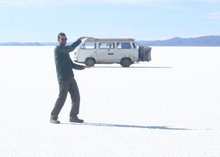
The roads have been hard on poor la Tortuga, and the turbo is broken.
The little thing inside that spins is supposed to have .5mm of wiggle, and it has 4mm!! So we’re stuck in Cuzco for a few days at least (we hope not more) waiting for a part. It’s Sunday the 29 of April, and we’ve been here for…2 weeks already.
Luckily, we couldn’t be stuck in a nicer place. Quinta Lala is a haven. It has everything we need, is right in a wonderful city, and is chock full of friendly and interesting travelers. We’ve probably met more people here than we have on our entire trip. We’ve been having a great time exchanging stories, places to camp, road recipes, and drinking boxed red wine. Apparently in Chile, all the wines come in boxes as well as bottles, and the quality is the same. It probably has something to do with the roads, and the impossibility of transporting glass bottles intact on terrible dirt or gravel roads. We certainly appreciate it!!
Douglas has been making friends by fixing everyone’s trucks – so far he has fixed Colin and Liz’s Ford (twice – that’s Ford for you) and two Land Rovers. We’ll see who’s next.
In the meantime, we’re taking advantage of the time to organize our lives. We have 6 weeks of travel left, at which point we’ll ship the van from Buenos Aires (assuming we make it there!) to the east coast of the US, where we’ll pick up our dog, Saira (she decided she didn’t want to come on this trip – too much time in the car). The van will be 3 weeks in transit, and we plan to spend that time visiting friends in NC and Boston, then we’ll pack everything in the van and drive over to Vancouver, where we’ll settle.
In the meantime, here’s an update of where we’ve been this year, and how long it’s taken us:
USA, NC to Texas: 2000 miles in 4 days Central America, Mexico to Panama: 4000 miles in 2 months South America, Ecuador to Peru: 3000 miles in 1 month
So far we’ve traveled 9000 miles, and we think we have between 2500 and 3500 miles to go, depending on which way we go, and what the roads are like. We hear they're pretty bad in Bolivia, but quite good in Argentina, Uruguay, and Brazil.
And, yes, people actually say ‘Ay, caramba’ here. It’s my new favorite curse. I don’t know exactly what it means, but the taxi drivers say it whenever something goes wrong.
On our way back to Cuzco, we decided to stop at the Sillustani ruins near Puno. We turned off the main ‘highway’ onto a small road that wound its way through a bewitching altiplano landscape.
At one particularly beautiful adobe compound, we stopped to take pictures, and the friendly family living there waved us in to see more. The kids were all wearing multicolored hats, and one of the women was wearing my new favorite type of hat, a tiny brown bowler perched at an angle, with a little tassle.
They showed us around their home, composed of several small round adobe buildings surrounding a courtyard.
In the back was a small pen for guinea pigs, a local delicacy. In this picture you can just see that there is a small hutch at the back for them to hide in, with a hole as a doorway. One of the guinea pigs was too fat to fit through the doorway anymore – we figured he was going to be lunch!!
When they were done showing us around the rest of the house, they took us into the weaving room and showed us their wares. Of course. Everyone’s gotta make a living. We bought one weaving made of llama, rather than the usual alpaca. Llama fiber is usually used for ropes, and has a coarser texture. It was actually quite soft, though, and reminds me of raw silk in its combination of strength and suppleness. The undyed llama wool had a really lovely shading of colors from palest cream to warm brown. One of my favorite textiles. I wish I had a picture of it to include, but I forgot to take one before I sent it back to NC with Beulah – she generously offered to take some of our extraneous junk home so we could have room to move in the van again!
Finally, since we will be passing through this way again (if we ever get our car part and get to leave Cuzco), we took some family portraits, promising to print them and give them to the family on our way back through. They were quite amazed that they could see the picture immediately on the screen of our digital camera.
Next we headed over the Sillustani ruins, which are pre-incan funerary towers.
I also got this nice picture of a woman spinning by the side of the path:
And just before we got back to Cuzco we passed through a small town fill to the brim with Sunday marketgoers in all their finery. The hats are just splendid.
After seeing Machu Picchu, we took a rest day and then headed south to the other main attraction in southern Peru, Lake Titicaca, home of the famous floating islands. The drive through the altiplano was stunning, with big snow-capped mountains on either side. We only made it as far as Pucara, unfortunately, and ended up staying in one of the eccentric “Turistic Hotels” that are so plentiful in Peru. We took off early the next morning for Puno, and arrived early in the day. We got Beulah settled into a hostel, and we found a parqueo run by a friendly family, then grabbed a taxi to see some of the small towns scattered along the southern shore of Lake Titicaca.
We went first to Chucuito, which is famous for its Temple of Fertility. As soon as the taxi pulled into the central square of the sleepy little town, two small kids approached and offered to be our guides. They of course had finger puppets on, hoping to make a sale. They were quite the young entrepreneurs, and even had a sales pitch worked up where they spoke in unison in sing-song voices. We were a little weirded out at the thought of having the Temple of Fertility explained to us by 5-year olds, but decided that they were old pros, and so we hired them.
The Temple is an old Inca site where women would come to make offerings of coca, hoping the gods would favor them with children. The central part of the temple, which no longer has a roof, is filled with carved stone phalluses, some as big as 4 feet! The older guide told us most of the story, then poked his business partner in the side to get her attention, and they ended by saying “and that concludes the story of the Temple of Fertility” in unison. They were pretty cute. When we paid them, we asked them who got to keep the money, and they said it all went straight to their mother, so we paid them with some chocolate, as well.
On our way back to Puno, we stopped at the tiny lakeside village of Chimu, where they are famous for making the reed boats. It must have been the wrong season or day, because we didn’t see any boat building, only reed-drying. Luckily, there was one small house that doubled as a museum and boat souvenir store, so we stopped. We first looked around the museum, where they had a spectacular collection of replicas of local birds and animals, and a large reed boat carrying the Inca King and his wife. It was pretty impressive, so we resolved to buy a small boat or two.
When we went downstairs, some of the boatmakers came out of their boatmaking room/living room to answer our questions, and to ask questions of their own about where we are from, what it’s like, etc. It turned out that one of the boatmakers was also a boat racer, who regularly takes part in (and wins!) the annual reed boat race on October 22.
The next day we took a guided tour out to the floating islands. The boat was typical for here, and only had one speed. When they wanted to start or stop it, the captain would leave the wheel and head to the back of the boat, lift a wooden cover on a hatch, and fiddle with the engine. Typical, yes. Safe, maybe not.
We arrived on the floating islands to see a veritable army of locals ready to greet us and sell us things. Our tour group sat in a semicircle to listen to the story of the floating islands, and to taste totora, the reed used to build both the boats and the islands. How multipurpose can you get?
Totora is extremely rich in fluoride; here is a picture of Douglas and Beulah getting a full day's worth of fluoride in one bite:
The folks who built the Uros Islands speak Aymara, a different language from most of the indigenous people in Peru, who speak Quechua. They are originally from the Amazon Basin, if I’m remembering correctly. They were persecuted by other nations in the area, and began living on floating islands to evade conflict with their neighbours. The islands are built by first cutting free a big mat of entwined totora roots from the edge of the lake. This mat floats to the top, and successive layers of totora reeds are laid on top. Every so often (depending on the season, as often as once a week) new reeds are laid down. After 20 years or so, the islands are so thick that they touch the bottom and have to be abandoned because of danger of flooding in the rainy season.
The boats are built out of totora reeds, as well. Originally they were made of pure totora reeds, and would only last for 3 months. Nowadays, though, the builders incorporate layers of plastic bottles, and the boats last for 2.5 years.
Overall, the visit to the islands was a bit of a mixed bag, and we have debated a fair amount about what to make of it. On the one hand, it was incredibly touristy, almost Disneyfied. Each island was essentially a floating souvenir shop, and we felt not just that these folks’ lives were impacted by the tourist trade, but that their lives were shaped by and for the tourist trade and almost nothing else. They were like a living museum exhibit.
On the other hand, they have found a way to preserve their unique way of life. Their community seemed fairly intact, and we didn’t get the impression that many families were split up because the husband (and maybe the kids, too) had left to work in a big city. They also seemed to be doing fairly well. The proceeds from the tourist visits are shared among the community, and have been used to build a big school, and to provide amenities like solar panels and international telephones on the island. In that respect, at least, the development was positive – the money is really going back to the community, and is being used productively.
Still, I don’t know if I would want to live in Disneyland, even if there were solar panels and good schools.
Enough seriousness - here is a video of a trici-taxi ride we took on our way to eat delicious cake in Puno. And a photo of the trici-taxis, which are quite common, and very fast!!
This amazing archeological site is often the highlight of many folks' trip to South America, and we are no different. Yes they bludgeon you as a tourist with a ‘special’ $73 US train ride and $12 bus ride and $40 entrance fee, BUT, the moment the sun rises above the site, producing a magical double rainbow behind the caretakers hut that all becomes irrelevant.
We started the journey on the 7am train from Cuzco and four hours later arrived in Aguas Calientes. Many paint a dismal picture of this town but I went in thinking of it like a ski resort and found it charming. The food and lodging was actually reasonably priced. We even had a magnificent 3 course meal at Indio Feliz, carefully prepared by a French chef and served by his attentive wife. All for $12. And of course we had to go back again for another round of the amazing desert.
In order to see sun rise, and avoid the crowds, we caught the 5:30am bus. We hired a guide, Ernesto, whom I wouldn’t recommend, and began the tour by climbing to the caretakers hut. This is where the Inca trail enters the site and from where the classic MP photos are taken. From there we descended to the main entrance, more wonderful rock work. I could go on and on for hours, but the pictures in the MP album may be more useful.
After the tour, my Mum headed back to Aguas Calientes and Kim and I climbed the narrow stairs to Wayna Pichu, the astronomers hang out high above the city. This was very well worth the hour hike and the clouds cleared just long enough for us to snap a couple photos of MP below.
Some of the coolest things about MP: Built around 1400 it was basically a university. The terraces were used to experiment with crops facing different directions and encompass multiple microclimates as they climb the slopes.
The water works are amazing! Channels carved into the rock with 16 water falls. The first water fall is ceremonial and the next 15 are for getting clean drinking water.
The round carved stones used to tie the roofs on and hold the doors closed.
The incorporation of the natural stone outcroppings into the buildings.
When we arrived in the morning it was drizzling rain and we feared the weather may not cooperate for us. But just as the sun rose the clouds parted a bit presenting us with a rainbow and a mystical Machu Picchu. The weather held all day with some light drizzle from time to time. We couldn’t have asked for better weather or a more wonderful day.
The train ride home was pleasant. I especially enjoyed the zigzag rail as you enter Cuzco. To overcome the steep climb out of the city, the train tracks zigzag, with an operator jumping out and switching the track at every zag, very similar to the Nariz del Diablo in Ecuador.
Once we had looked around Cuzco a little bit, we decided to head to Pisac for its famous Sunday market. There are also some Inca ruins nearby (there are ruins everywhere in this area – a 5 minute walk from our campground there are some small, unmarked ruins). The market was the usual mixture of touristy crafts and everyday things for the locals, and we very much enjoyed looking around at everything. Beulah and Douglas tried out some choclo, which is local corn with HUGE kernels, very tasty:
We decided to pass on the local remedy for joint and muscle pain, though:
After we had had a good look around the market, and sat in the shade to drink some coffee, we decided to take a short taxi ride to the Pisac ruins. The site was divided into two major parts, the agricultural part, and the ceremonial part. There were numerous curved terraces for growing crops in the agricultural section.
And there were ceremonial baths where pilgrims could purify themselves before entering the ceremonial section.
The site was sprawling, and involved a lot of climbing along narrow winding paths that hugged the steep cliffsides.
So we arrived in Cuzco the day before Beulah was due to arrive and settled into the wonderful campground of Quinta Lala. It’s run by a Dutch couple, Gonna and Helmie, and is just perfect. It has everything an overlander needs, including lots of other overlanders to talk to!! And, my favorite, just about every morning a herd of alpacas comes in to graze the lawn.
Beulah arrived the next day, quite early in the morning. We picked her up at the airport, then got her settled into the one small room at Quinta Lala (usually reserved for campers rained out of their tents).
We went first to Sacsayhuayman (it sounds a little like sexy woman), the Inca ruins that are right next door to our camp spot. They are built on a ridge that overlooks the city of Cuzco, and the stones used in the construction are absolutely gargantuan. It was our first sight of the famous Inca stonework, and it was truly impressive. The largest stone weighs more than 350 tons, and some of the join work defies the imagination – one stone can have as many as 30 angles! These gargantuan stones fit together perfectly, with not even enough room to slide a piece of paper between them.
The Incas were engineers, all right. Their constructions were remarkably earthquake-proof, as well, and have survived a number of large earthquakes that leveled most other nearby buildings. All of the walls have a slight angle, between 8 and 14 degrees, that makes them more stable. They are also built on a foundation of small, round stones, so that when the earthquake hits, the walls can shift on their rolling foundations without collapsing. Amazing.
We had a guide to explain the site to us, and we really enjoyed hearing the extra information. Otherwise it would have just been another beautiful pile of rocks. We wouldn’t have known that Cuzco is built in the shape of a puma, and that Sacsayhuayman is the puma’s head, since it was the ceremonial site. Nor would we have known that the Incas carved their stones with meteorites, and slid them into place on huge leaves of aloe, which then served to help glue the stones together.
The name Saxsayhuaman means satisfied falcon. The site was renamed when the Spaniards slaughtered hundreds of Incas here, and their bodies were left out for the falcons to eat.
After dragging poor Beulah around this pile of rocks (she had come up to 3300m from sea level, and was feeling the altitude) we decided to take a turn around Cuzco and see what we could see. The city is absolutely gorgeous. Tiny river stone streets wind their way in between lovely colonial buildings, some of them with remnants of Inca stonework at the base. The buildings off the central square have elaborately carved wooden balconies. And mountains ring the city, giving you a sense of distance and space whenever you look up from the lovely architecture. Here is a picture of the narrow streets:
It is, of course, VERY touristy, and every time you step into the square you are swarmed by folks trying to sell you finger puppets, postcards, or dinner in their restaurant. Beside the expensive restaurants are stores that sell jewelry and fine alpaca sweaters for hundreds and thousands of U$. But somehow it’s still a nice city.
Another tactic often used to part tourists from their dollars is to dress up in traditional garb, pose with a well-brushed llama or alpaca, and ask for money for taking photos. We took some funny pictures of these two boys with their llamas.
And as we were walking down a central street, looking for coffee and cake, an indigenous woman in full regalia stuffed a baby goat into my arms, and then demanded money for a photo. The goat of course started to poop, and I nearly dropped it. But we got a photo anyhow, and Douglas helped me pick the little balls of goat poop off my clothes afterwards.
After some cake, to revive us, we headed over to a local craft cooperative called the Center for Traditional Textiles of Cuzco. Here they try to preserve the weavers’ art by selling really fine woven goods for fair trade prices, and encouraging children in villages to learn spinning, dyeing, and weaving from their grandparents. In the center of the store, surrounded by the beautiful and varied types of weaving produced by different village traditions, were four weavers using backstrap looms. All the thread is hand-dyed with natural materials, hand-spun with drop spindles, and then woven into intricate patterns. It was incredible to watch – the amount of time needed to produce a single row of weaving was impressive. Here is a video of a weaver at work:
And I can't close this blog entry without mentioning that sweet sweet Beulah brought us the porta potti we've been looking for in every city since Antigua. We are both pleased as punch. Here is a picture of Douglas testing it out:
A quick note. We´ve been having a great time with Douglas´ mom. We spent some time in Cuzco, ate some delicious food, shopped for crafts, visited Machu Picchu, and are now in Puno, on the shores of Lake Titicaca. Tomorrow morning we´re planning to take a boat out to see the famous floating islands.
We also posted a LOT of videos these past days. Check out the video link. Some are from as far back as Nicaragua!
night 132 *** side of road across the street from Hotel Laboulaye, Laboulaye, AR. free. S34.13234 W063.39148 Unexpected free WiFi from the hotel across the road. Fantastic.
night 131 *** Parqueo on La Rioja, just south of Zapata in Mendoza, AR. 12 pesos for 24 hours. S32.89765 W068.83721 Friendly parqueo, centrally located.
night 130 * Luz y Fuerza camping outside Mendoza, AR. supposed to be 30 pesos (scandalous!) but we snuck out without paying. They didn't even have running water for us, nevermind bathrooms or showers!! 30 pesos!! ha!
night 129 *** Municipal camping in Rodeo, AR. 6 pesos (but there was no one there to pay, so free). S30.20790 W069.13367 Nice campspot in a small town. This part of the country is gorgeous - make sure to visit the Penitents at Paso de Agua Negro.
night 127-128 **** Visitors center at Ischigualasto National Park, AR. 6 pesos. S30.16756 W067.84479 Very friendly rangers, hot showers, and a park at your doorstep.
night 126 *** Camping just south of Monteros, AR, on Ruta 38. 12 pesos. S27.18451 W065.50249 Really hot showers, made hot by a bamboo fire lit under the hot water tank. Who could ask for more?
night 124-125 **** Camping Lorohuasi, Cafayate, AR. 9 pesos. Just south of town on Ruta 40. We biked into town to sample wine and visit bodegas. Wonderful!
night 122-123 *** Parqueo across the street from Hostal Condor Pass. 15 pesos for 24 hours. 3 pesos for a shower at the hostal. A good spot, right in the center of town, near excellent cafes and pastry shops.
night 121 *** Tres Cruces, AR. free. S 22.91920 W 065.58861 parked by the church in this small town. The kioskas nearby sell excellent salami. A bit noisy, but good.
night 120 **** Hotel Mitru, Tupiza, BL. 20 bolivianos. Nice parking spot in their garden, excellent book exchange.
night 119 *** Side of the road south of Uyuni.
night 118 *** Isla Incahuasi, Salar de Uyuni. 10 bolivianos. S20.23931 W067.62229 we camped on the side of the island without infrastructure, but they found us anyway. The money is all used for community development and conservation, so we were happy to pay. The ranger, Victoria, is very interesting to chat with.
night 117 *** In the desert off the side of the road, south of Rio Mulatos, BL. Saw emus in the morning.
night 116 *** Parqueo of a Hotel in Oruro, shoot we forgot to write down any details. Fine.
night 115 *** outside police station in the central square of Chucuito, PE. Free. Nice. Quiet. Friendly police officers.
night 102 - 114 *****Quinta Lala in Cuzco, PE. We're waiting for the new turbo for the van and will be here until it arrives. Luckily it's a tremendously nice place to be stuck!!
night 101 * Turistic Hotel in Pucara, PE. We just ended up back here, and had another sub-par night's sleep.
night 100 ** Parqueo across from Los Uros Hostal in Puno, PE. 6 nuevos soles. Not a bad parqueo. They also washed our car for 5 soles.
night 99 * Turistic Hotel in Pucara, PE. 35 soles for a room, we parked in their lot, next to the mail road.
night 97-8 back at Quinta Lala, hooray!
night 96 *** La Payacha Hostal in Aquas Calientes, PE. $25. Not a bad option in expensive Aguas Calientes.
night 93-95 ***** Quinta Lala in Cuzco, PE. 26 nuevos soles. A true overlander spot, with a big lawn full of other overlanders, hot showers, laundry, kitchen, etc. They can also recommend lots of things to do and see in and around Cuzco.
note - Cconocc Hot Springs, about an hour east of Abancay, would be a lovely place to camp. We stopped for lunch and a quick swim. Look out for the tiny biting flies - the bites itch like crazy for days!! Turnoff is at S13.54855 W072.64048 and the hot springs are down a small dirt road at W13.54278 W072.63858
night 92 ** Hostal Turistico in Abancay, PE. 20 nuevos soles. Nice big cochera, bathroom and water available.
night 91 * Hostal Jousef in Puquio, PE. 10 nuevos soles. S14.69476 W074.12465 Parked in their cochera. Toilet available, but no water. Very inattentive staff, and they changed the price at the last minute.
night 88-90 **** Bananas Hotel in Huacachina, PE. 20 nuevos soles. S14.08689 W075.76365
night 87 *** Reserva Nacional de Paracas, PE. 10 nuevos soles. S13.83282 W076.30373 Beautiful campspot on the beach. Bathroom facilities disgusting beyond words.
night 86 *** Parqueo in Huacho, PE. free, after we gave them our fold-up chairs, which they loved. Otherwise, 3 nuevos soles for the night. S11.10411 W077.59616 The family was super-friendly and very happy to welcome long-distance travellers. They wanted to know everything about our trip. They also opened up a block of showers and toilets for us.
night 85 * Hostal Blanco, Yungay, PE. 40 nuevos soles. not recommended. Got stuck in the mud and shorted out the whole compound trying to have a hot shower.
night 84 **** Plaza de Armas, Yuramarca, PE. free. S08.73756 W077.90399 We felt like we had landed the mother ship on another planet. No one had seen anything like us before. They were very welcoming and *very* curious.
night 82-3 ***** The Garden hotel, Huanchaco, PE. 25 nuevos soles. very near Nice hotel in a cute beach town. They let us park on the lawn by the pool, and use the *hot* showers in one of the rooms. Excellent.
night 81 *** Garaje in Lambayeque, PE. 3 nuevos soles. S06.70602 W079.90399. 21m. Nice parqueo in a quiet town, run by a *very* friendly family.
night 80 * Parqueo in Piura, PE. 18 nuevos soles. Only place in town that would have us. Doubled as a chicken coop.
night 79 * Hostal Tenguel, Tenguel, EC. $10. Cold showers, parked on the street out front of the hotel. Motorcycles without mufflers circled us all night long.
night 77-78 ** Parqueo in Cuenca, EC. $2. No facilities, central to town.
night 74-76 *** El Pedron, Banos, EC. $16 for the room while I was sick, $6 to camp.
night 72-73 *** La Luna hostal, Otavalo, EC. $6.
night 71 **** Cotopaxi National Park. S00.63667 W078.48397. $26. Spendy, no services. Amazing views and hikes. no other people.
night 69-70 ***** Posada Tigua. Near Quilotoa S00.94724 W078.85661. $4. Working Posada, great food, great hosts, felt like we were at home.
night 68 * Rocafuerte Av. Guaranda, EC. Free. Quiet side street near the park. Level.
night 67 * Guaranda Central Square, EC. Free. Nice benches. Busy in the am.
night 66 * Chimborazo Refugio, EC. $10. Only vicunas live here, and we found out why, at 5000m it was a bad nights sleep.
night 65 *** Hotel Las Flores, Guaranda, EC. $16. Clean, quiet and safe, no parking. Parked down the street at a garage.
night 64 ** Central Square in Salinas, EC. Free. These folks get up early, and get really excited with the church bells around 5:30.
night 59-63 *** Hotel Pacifico, Guayaquil, EC. $16 Clean, Quiet and safe, right downtown and near the Malecon. Has a garage.
night 58 *** Hotel Tren Dorado, Riobamba, Ecuador. $16. Very cute, right next to the train station.
night 57 ** Hotel Picket $16, Quito, Ecuador A bit noisy and hotel door didn't lock very well.
night 56 -** Panama city airport. Free. Slept under a bench for a few hours each, in shifts, as we forgot the alarm clock and didn't want to miss our flight. We miss the van.
night 54-55 ** Balboa Yacht Club. Panama City. Free. WiFi. Bar. Never really spoke to anyone except to get more beer.
night 53 *** Outside the ranger station at Parque Nacional Soberania, just north of Pedro Miguel Esclusas, Panama. Free (though this seems variable). Everyone was very friendly and we met their pet Toucan.
night 52 *** Outside the police station, El Valle, Panama. Cokes for the policemen. N08°36.262' W080°07.729' The police officers were very nice, helped us find a flat place to park, indicated where there was a water tap we could use. They would not accept beer as payment (we're not in Nicaragua anymore, toto). Nice quiet safe place in the middle of a cute town, but no bathrooms. Across the street from the Sunday market, too!!
night 51 * outside Hotel Little Mozart, Boquete, Panama. free. * No one was around at the hotel to let us in (they offer camping), so we parked outside in a well-lit area and slept there.
night 50 * Parqueo, San Isidro de la General, Costa Rica. 3500 colones. Terrible. A parqueo in the middle of town, right next to a disco that played LOUD 80's music unti the wee hours. What is it with 80's music in Central America??
night 48-49 ** Gaudy's, San Jose, Costa Rica, 5,000 Colones, Parked and slept in their parking lot. Free internet and friendly staff. No loud music, hooray!
night 47 **** Finca los Maestros, Orosi, Costa Rica, free (visited the school and will be penpalling with the students) N09°46.032 W083°47.392. Parked near Gabriella and Mirella's house, were welcomed to use the bathroom and get water. The scenery, filled with coffee plantations and cloud forest was worth the short trip from San Jose.
night 45-46 ***** Parque Nacional Braulio Carrillo, Costa Rica. 8,200 colones. N10°07.819' W084°07.523' Parked the van next to the ranger station inside the gates. A bit of a bumpy and steep dirt road, not suitable for very large campers, though you could park outside the gates. Freindly ranger and incredible cloud forest with gorgeous views of the central valley (SJ).
night 42-44 * Pangea hostel. San Jose, Costa Rica. 10,600 colones. N09°56.232' W084°04.587' A good safe place to park the van while we work on it and wait for the boat to Ecuador. Yummy food, nice staff. Unfortunately it's full of 20-something dreadlocky backpackers who start drinking at 8:30am (seriously) and keep the music pumping until 1am. ugh. not much sleep to be had.
night 41 **** Palo Verde National Park, Costa Rica. free (we're not sure it was supposed to be). N 10*20.783' W85*20.793'. More birds than we've ever seen in one place. They sky darkened when they took off. Amazing.
night 40 * San Juan del Sur, Nicaragua. Outside police station, free. N 11° 15.028 W 085° 52.399. Friendly police, near beach, right in town. Water nearby.
night 38, 39 ***** Little Corn Island, Nicaragua. Ensuenos 270 cordobas.Heaven on earth. You feel like you have your very own tropical beach.
night 37, 38 ** Little Corn Island, Nicaragua. Grace's Cool Spot 140 cordobas. Close to the beach, good food, the most uncomfortable bed we've *ever* slept in.
night 35, 36 * Granada, Nicaragua. Parqueo near Central Park 50 cordobas. A parqueo. Centrally located. No facilities. (Wed - Sun the van stayed here while we went to LCisland, 350 cordobas)
night 34 *** El Paraiso, Honduras. Quinta Avenida Hotel 225L. Private bathroom with hot water shower (the hottest since Asheville!!). The TV in the room kept us up way too late. Close to the Nicaraguan border (30min)
night 33 *** Lake Yojoa, Honduras. Los Naranjos archeological site, free (bought the guard a coke) GPS: N14*56.384' W088*01.199' They seemed to welcome us with 4 military guards watching over the sort of enclosed grounds. It seemed like we are also expected to see the ruins in the morning. $5US each, gulp.
night 32 * Copan Ruinas, Honduras. Texaco Station, 50L. GPS: N14*50.351' W089*08.853' it's a gas station, but there's a guy with a big gun across his lap sitting in the parking lot all night, and we paid him to camp here, so we guess it's OK. Terrible nights sleep due to passing truck traffic. Spoke with someone else who boondocked in central square with no problems.
night 31 *** Chiquimula, Guatemala. Hotel Hernandez, 50Q. GPS: N14*48.096' W089*32.703' a very happy and happening hotel. shared bathrooms are *tiny* but clean, and it's right in the town center, close to several *wonderful* supermarkets and an internet cafe. It also has a pool just barely big enough for laps.
night 28-30 ***** Poptun, Guatemala. Finca Ixobel, 44Q. GPS: N16*18.215' W089*25.216'lovely friendly ecological inn with a great kitchen serving delicious cheap meals. A great place to rest and recharge before hitting the road again.
night 26-27 ***** Tikal, Guatemala. Tikal Ruins Campground, 60Q. GPS:N17*13.493' W089*36.699 walking distance from the ruins, with clean bathrooms and showers, near to some nice small cheap restaurants, very hot and buggy, monkeys, parrots, toucans, Peten turkeys, and other unrecognizable animals roaming through the campground
night 25 *** El Remate, Guatemala. Gringo Perdido Ecological Inn 50Q. right on Lago de Peten Itza (crystal clear turquoise waters, nice swimming, breezes to keep the mosquitos away), with pit toilets and a sink with water
night 24 ** Salama, Guatemala. Hospedaje Juarez, 50Q (and the attendant was willing to cut us a deal for less if we left before 7am when his boss showed up, but we didn't want to get up that early) a secure parking spot in a cheap hotel, OK bathrooms and nasty showers
night 22,23 * Antigua, Guatemala. Los Encinos Parqueo, 40Q per day. a parking lot. dirty bathrooms. but right in the center of town. 3era Calle Poniente #28, tel 7832-0553
night 21 ***** Panajachel, Guatemala. Hotel Tzanjuyu, 75 Q. gorgeous spot on the lake, clean bathrooms and hot showers, close to the markets in Chichicastenango and Solola
night 7-20 ***** Xela (Quetzaltenango), Guatemala Home Stay while studying spanish with Celas Maya. Highly recommend this school, beautiful courtyard setting for studying with great teachers. 5hrs 1 on 1 instruction with room and board - $130us/wk
night 6 **** Lagos de Montebello, Mexico Camping area within national park, 20 pesos. Parking by Ranger station and Orchid green house, no shower, clean bathroom inside Ranger station, friendly rangers
night 5 *** San Cristobal de las Casas, Mexico Camping place s.e of town (walking distance), 80pesos. spotty water supply, decent, lots of cats.
night 4 *** Catemaco, Mexico eco camping place outside of town, 80 pesos
night 3 **** Emerald Coast, Mexico campground in Mexican camping, 140 pesos
night 2 * Ozuluama, Mexico can't remember hotel name, 280 pesos had to pay for a room to camp there, so had a hot shower
night 1 ** La Pesca, Mexico La Gaviota Hotel, 180 pesos nice view, lots of pelicans, kind of expensive and a little run-down. Bathrooms, cold showers.